North America
Book of EstherNorth America appears in the book’s account as one of the great regions newly opened to European voyaging and, in the author’s providential interpretation, to future efforts on behalf of the Bible. Its significance lies less in a description of the continent itself than in the way its discovery becomes part of a larger argument: geographical exploration, like the development of means for reproducing and circulating books, helped prepare the world for the promised spread of the gospel.
Discovery and the Opening of the Continent
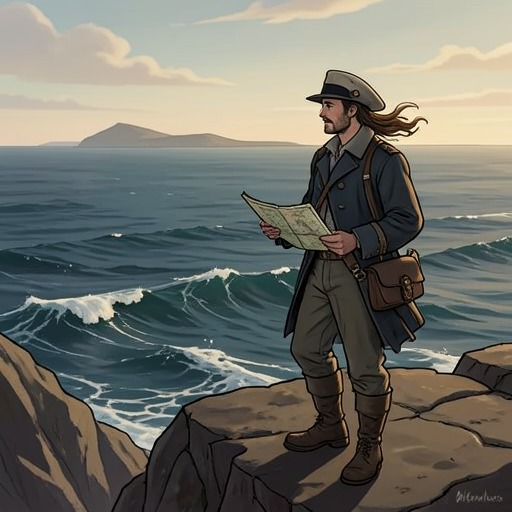
The author places the discovery of North America within a sequence of voyages driven by the search for a route to India. Columbus, brought to Portugal and acquainted with its nautical skill, was employed by Spain to sail west. In 1492, he discovered the West Indies; in 1498, he discovered the continent of America. The book treats these discoveries as stages in an expanding knowledge of the habitable globe, rather than as isolated maritime accomplishments.
The account sets Columbus’s voyage alongside the Portuguese arrival in India by way of the Cape of Good Hope, also dated to 1498. Citing Dr. Robertson, the author argues that people in the fifteenth century made greater progress in exploring the inhabited world than in all the ages before it. North America consequently belongs to a transformation in the perceived scale and reach of the world: lands that had been beyond European knowledge were now described as open to further activity.
A Providential Geography
The author interprets the opening of North America and other newly reached regions through a theological account of history. The newly accessible countries of North and South America, together with the East Indies, are presented as inviting the exertions of the friends of the Bible. Discovery thus has a purpose in the book beyond the acquisition of geographical knowledge: it enlarges the field in which the gospel might be carried.
That interpretation is part of a broader claim that historical developments can serve purposes their human agents may not have intended. The desire for discovery, the pursuit of glory, and the ambition to reach distant regions may motivate individuals, the author argues, while providence directs the consequences toward the worldwide proclamation of the gospel. North America is therefore situated within a global horizon of anticipated religious expansion, not discussed as a separate political or cultural history.
Exploration and the Gospel’s Intended Reach
The book extends its account beyond Columbus’s voyages to later exploration by Captain Cook and other British seamen. It describes distant islands as already submitting to the gospel and treats the continuing urge to explore as a force that will carry people to remote and dangerous places. These examples concern exploration across the globe, rather than specific events in North America, but they reinforce the author’s central connection between access to distant lands and the reach of Christian mission.
The argument ultimately rests on the author’s reading of a divine purpose for the gospel to be preached throughout the world. North America matters within that argument because it is included among the regions made accessible by exploration. The continent’s narrative role is consequently both geographical and prospective: discovery enlarges the map of places open to human contact, while the book presents that enlarged world as a field for the Bible’s future circulation.